
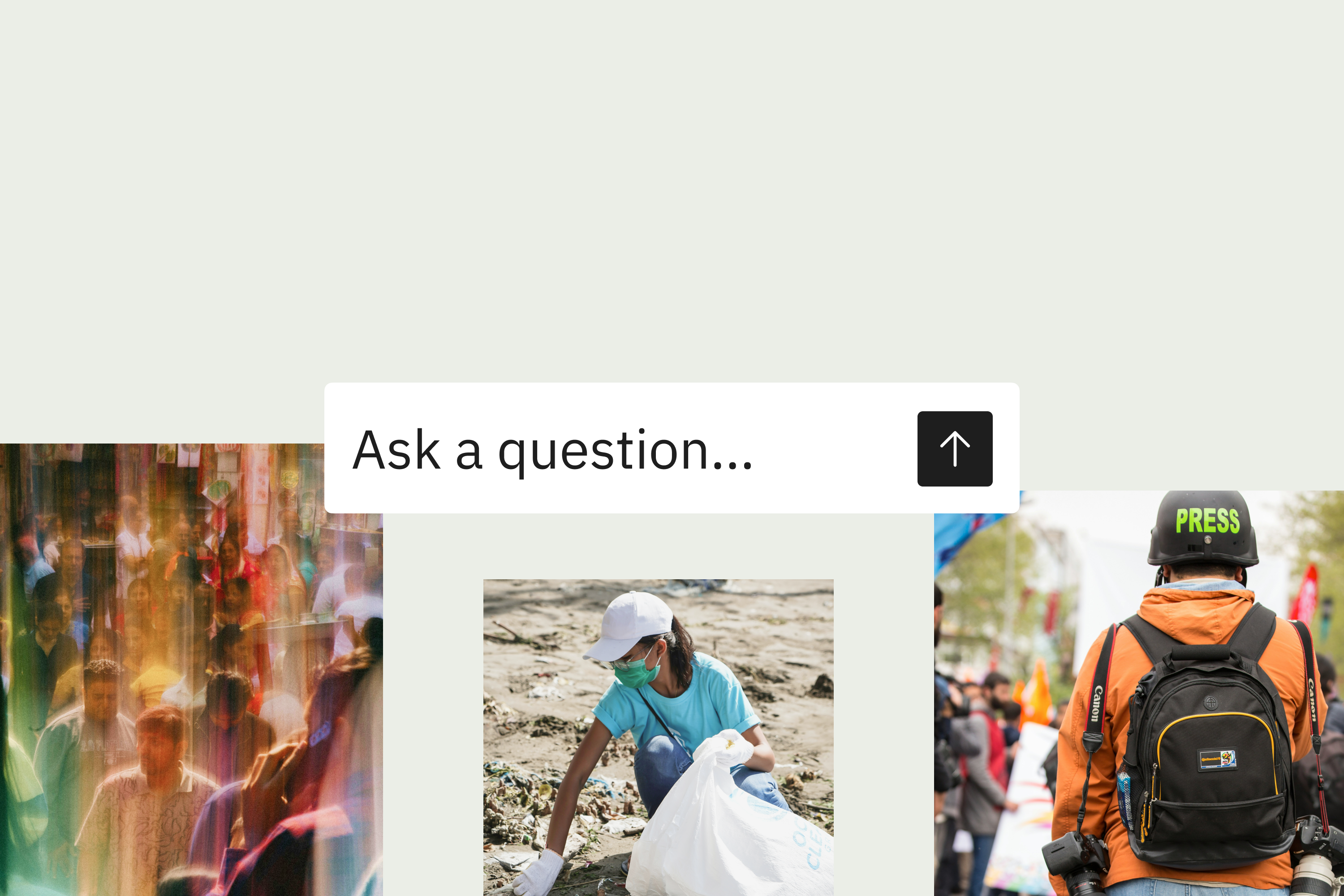
We are launching a chatbot into a world where information is weaponized and local journalism hollowed out, where AI identifies targets and coordinates strikes, where people in Lebanon, Gaza, and the wider Larger World are navigating decisions about their health, their safety, their basic rights, and their survival within information ecosystems that have been fractured and deliberately distorted. It feels like it's the last thing the world needs right now.
Yet here we are.
The dominant AI systems of our time are built on English-language data, optimized for English-language users, and deployed everywhere else as a kind of afterthought. They answer from the open internet, thus reproducing the same inequalities we have spent years organizing against. They don't know what they don't know, and they won't tell you when they're guessing. This lack of algorithmic transparency is precisely what makes public interest organizations more hesitant to embrace the affordances of AI technologies: none of the options they see advertised seem to resonate with their needs, or serve their mission.
Meanwhile, the organizations that actually hold verified, trusted, community-relevant knowledge — newsrooms, civil society groups, health advocates, human rights defenders — have that knowledge buried in archives, PDFs, and the heads of overworked staff. The people who need it most are looking elsewhere, or not looking at all. And when they do search, they find misinformation before they find anything useful.
This is not a technology problem; it's an equity problem. So we spent the past 18 months building something different: technology that respects and amplifies community knowledge systems, drawing from trustworthy local reporting, grassroots research, and community-validated information, thus providing access to AI affordances, with full transparency and accountability.
Suwali is a conversational AI platform built for mission-driven organizations that need to make their knowledge accessible to the communities they serve, without a six-figure budget or a dedicated tech team to do it.
Every answer Suwali gives is grounded in the organization's own verified content. When the answer isn't there, Suwali says so. That's not a limitation; that's the whole point. I like to think we built a humble bot. One with the humility to say: I don't know, but maybe I can learn from you.
It speaks the languages of some of the people we care most about: Arabic, Hindi, French, Spanish, Portuguese, English today, with more to come. It lives where our communities already are: in closed messaging apps. It doesn't ask anyone to log in, create an account, or identify themselves, because for many of the people Suwali is built for, privacy isn't a preference, but a survival mechanism.
We built it this way because our design partners kept us on our toes. They pushed us to think harder about what this tool must never become.
Now let me tell you why Meedan is building a SaaS product, because that part of the story matters too.
This year, information integrity disappeared as a strategic priority from some of the sector's most influential funders. I keep making the same argument: that information equity is a human right. That access to context-aware, language-appropriate, verified information underpins decisions about governance, health, reproductive rights, survival. That you cannot separate feeding and educating people from informing them.
And yet, philanthropy is walking away from the infrastructure of information equity.
We decided that we couldn't afford to wait to be funded into existence, and that we needed to build toward sustainability on our own terms.
That means Suwali is also Meedan's path to financial resilience — and we think of financial resilience as our own form of resistance. We operate on a hybrid model: philanthropic partnerships fund our public interest work and subsidize Suwali licenses for partners in the Larger World and for the programs we care about most, such as gender-based violence, sexual and reproductive health rights, information access under repression. Commercial licensing to organizations with the means to pay funds the infrastructure that makes all of it possible. We have no exit strategy, no investors to satisfy, and no profit motive. Our model is built around one simple premise: we want to become financially sustainable so we're able to reinvest in the technology that best serves our partners and our communities.
We launched with design partners across the US, India, Lebanon, and Egypt, and with organizations working in conditions that are demanding: on sexual and reproductive health rights in Arabic, in Lebanon and Jordan, where talking about women's bodies is surveilled and repressed. On independent journalism in Hindi, in a country where free speech is under threat. On civic information for US newsrooms that are under unprecedented pressure from a government that has made it its #1 task to vilify journalism.
We haven't solved the hard problems yet. Making Suwali work well for Arabic, and for other low-resource languages where the needs are urgent yet tech tools have historically failed, remains frontier work. But we are committed to doing better.
What we know is this: when an AI speaks your language, is grounded in knowledge you trust, and has the discipline to say I don't know rather than invent an answer — that is infrastructure. Infrastructure that helps communities resist misinformation, allows organizations to re-engage their audiences, offers people reliable answers to questions they were afraid to ask out loud.
Does the world need another chatbot? Not really.
Does it need AI that is built with communities rather than deployed on them, that speaks their languages, respects their privacy, and isn't designed to extract their data to feed it to commercial tech?
Yes. Urgently. And we're building it.