
By Amaralina Xavier, Senior Program Manager, Latin America and the Caribbean at Meedan
Rede de Jornalistas Pretos (Black Journalists Network) has launched Latinas IA, a virtual assistant built on Suwali that offers trustworthy, immediate guidance to women communicators and journalists across Latin America who face digital threats.
Based in Brazil, Rede JP works to make media ecosystems more just, diverse, and democratic. The network supports Black journalists and communicators through capacity-building programs, research, policy advocacy, and technological innovation, and its work extends internationally through coalitions such as the Pan-African Caucus of Journalists of the African Diaspora and the Red de Periodistas Afrolatinos. Latinas IA grows out of REPCONE, the network's digital protection program for Black women communicators, created with support from the Mozilla Foundation and Fundo ELAS+.
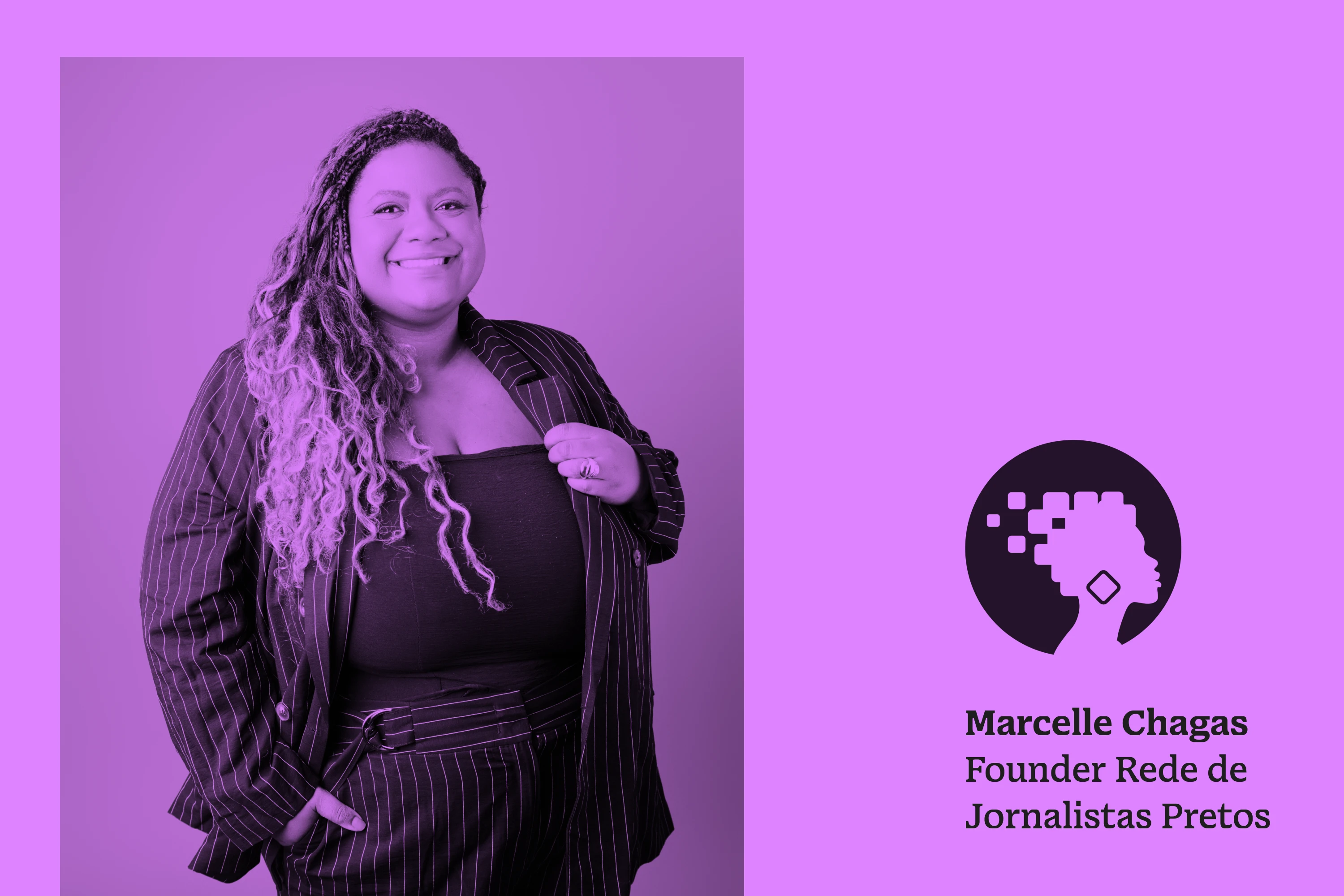
I spoke with Marcelle Chagas, founder of Rede de Jornalistas Pretos, about why the network built Latinas IA, what the collaboration has looked like, and where the work goes next. The conversation has been lightly edited for length.
For readers meeting you for the first time, how would you describe Rede de Jornalistas Pretos?
Rede de Jornalistas Pretos is a civil society organization committed to strengthening more just, diverse, and democratic media ecosystems in Brazil and around the world. We are not a traditional newsroom. Our mission is to create opportunities, strengthen capacities, and develop innovative solutions that enable journalists, communicators, and civil society organizations to produce high-quality journalism in safer, more sustainable, and more representative environments.
We lead initiatives such as the Black Media Coalition (Articulação pela Mídia Negra), which brings together dozens of organizations to advance public policies that promote diversity and equity in media, and we represent Brazil within the Pan-African Caucus of Journalists of the African Diaspora. Our commitment is to ensure that technological innovation serves inclusion, diversity, and equal access to reliable information.
Your work sits at the intersection of journalism, technology, and human rights. How has AI changed the landscape for the communities you serve?
Artificial intelligence has fundamentally transformed how information circulates online. While it creates new opportunities, it can also reproduce long-standing inequalities when algorithms are developed without diversity, transparency, or accountability. Civil society organizations, independent media outlets, and journalists working on human rights issues often face significant challenges in reaching broader audiences through digital platforms. In many ways, exclusion is no longer only economic or technological. It has also become algorithmic.
This is why we advocate for responsible AI that is transparent, inclusive, and grounded in human rights. Technology should amplify historically underrepresented voices, strengthen public-interest journalism, and reduce inequalities rather than deepen them.
What led you to build Latinas IA? What challenge were you trying to solve?
Our main objective was to provide rapid and trustworthy support to women communicators and journalists facing digital threats across Latin America.
The initiative builds on years of work in research, capacity building, and digital innovation. Recently, we collaborated with Thomson Media on an international study examining the sustainability of independent journalism, which deepened our understanding of the structural challenges facing news organizations and journalists worldwide. At the same time, we have been developing programs focused on digital protection and digital rights. One of these is REPCONE, the Digital Protection Network for Black Women Communicators, which provides training in cybersecurity, digital rights, psychosocial support, legal guidance, and leadership development.
Throughout this work, we identified a recurring need: many communicators require immediate guidance when facing online harassment, disinformation campaigns, doxxing, and other forms of digital violence. Human support remains essential, but by itself it cannot respond at the speed and scale these situations demand.
That is why we created Latinas IA. Powered by Suwali's technology, it transforms years of practical knowledge into an accessible tool that provides reliable guidance whenever communicators need it. For us, technology does not replace people. It expands our ability to protect them and democratizes access to trusted knowledge.
What has it been like working with the Suwali team?
The experience has been extremely rewarding because it combines complementary expertise. Rede JP brings years of experience in journalism, digital rights, innovation, and community-based work, while the Meedan and Suwali teams contribute deep expertise in responsible AI and conversational technologies. Every conversation flow and every response has been built upon our accumulated experience from research, field projects, and initiatives such as REPCONE, combined with the technical expertise of our partners.
One of our greatest learnings has been realizing how artificial intelligence can translate complex methodologies into practical, accessible guidance available in real time.
What excites you most about Latinas IA?
Its ability to democratize access to specialized knowledge. Digital attacks can happen at any time, and many communicators do not know how to recognize digital threats, understand their rights, or find trustworthy support. Latinas IA provides immediate guidance, helps users identify situations of digital violence, offers practical protection strategies, and directs them toward reliable resources.
It also significantly expands our organizational capacity. As a civil society organization, our resources are limited. Artificial intelligence allows us to reach many more people while maintaining consistency, quality, and continuous availability. More than a chatbot, Latinas IA represents a new way of making Rede JP's knowledge accessible to women communicators throughout Latin America.
What advice would you give other organizations considering conversational AI?
Start with the community's needs, not with the technology itself. Artificial intelligence only creates meaningful value when it addresses real problems experienced by real people.
Organizations should involve subject-matter experts, engage users throughout the design process, protect personal data, continuously review content, and establish clear ethical principles around transparency and accountability. Technology should complement human expertise, never replace it. When developed this way, AI becomes a powerful tool for social transformation.
What do you hope to achieve over the coming years, and how does Suwali fit into that vision?
Over the coming years, we aim to establish REPCONE as one of Latin America's leading digital protection initiatives for women communicators, and to position Latinas IA as a regional reference in the responsible use of artificial intelligence for digital rights, journalist safety, and democratic resilience. We also plan to expand our research agenda, develop new technological solutions for civil society organizations, and contribute to public policy discussions on technology, communication, and human rights.
Suwali is a strategic partner in this journey because it enables us to transform our knowledge into accessible, scalable, and publicly available tools. Ultimately, we hope to demonstrate that artificial intelligence can reduce inequalities, strengthen journalism, protect communicators, and expand access to trustworthy information when it is developed with communities and guided by human rights principles.
Latinas IA is part of a growing group of assistants that partners have built on Suwali to bring trusted knowledge closer to their communities. To see it in action, say hello to Latinas IA on WhatsApp. Organizations interested in exploring what Suwali could do for their communities can send us a message.